From Typist to Conductor: How I 10x'd My Code Output with an AI Agentic Workflow
In Chile, there is a popular proverb: “El que sabe, sabe. El que no, es gerente.” (He who knows, he knows. He who doesn’t is a manager).
As a former Amazon TPM and IT Director, I recently felt the sting of that proverb. I realized I was losing touch with the actual handcraft of software engineering in the AI era. To manage the inevitable future of mixed human-AI teams, I couldn’t just read about it. I needed to go back to the trenches.
I spent the last 8 months tracking my GitHub data, trying to figure out how to actually integrate AI agents into a local enterprise workflow using tools most of us already have: VS Code, GitHub Copilot, and Google AI Studio.
What I found shocked me: Treating AI like an open-ended “chat” is actually making us slower.
The Problem: The “Lazy” LLM
LLMs are trapped in the “attention economy.” They are inherently lazy and will take dangerous shortcuts—even butchering production code just to make a unit test pass—because they lack the “World Models” that AI pioneers like Yann LeCun warn us about. They cannot predict the real-world consequences of their actions.
When you leave a chat open too long, the AI suffers from Context Pollution. Your brilliant “Senior Architect” persona quickly degrades into a lazy Junior Developer mimicking your messy conversation history.
I realized I couldn’t just hand over the keys. I needed a system to constrain the AI.
The Solution: Files as Contracts
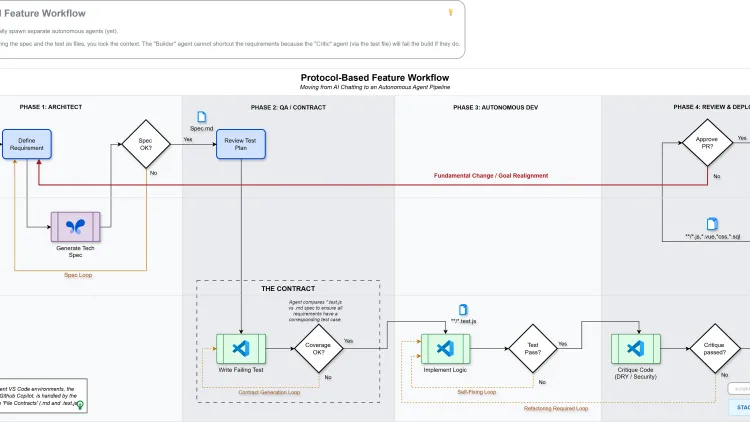
Instead of relying on chat history, I built a strict, 4-phase Protocol-Based Agentic Workflow. I stopped “chatting” and started orchestrating.
By strictly isolating context into separate Agent Personas and forcing handovers via Markdown and test files, I created an impenetrable boundary for the AI. I call this Files as Contracts.
The workflow looks like this:
- The Architect (Google AI Studio): Decomposing the macro-architecture into a steady flow of isolated, highly structured Markdown feature specs.
- The QA Lead (VS Code): Writing failing test suites based only on the spec. This failing test becomes the immutable Contract.
- The Autonomous Dev (VS Code): Looping against the failing test until it turns green, without ever modifying the test itself.
- The Code Reviewer (VS Code): An AI persona acting as strict police, checking for DRY, SOLID, and security principles before I personally give the final PR approval.
The Result: A 10x Output Bump
By inserting myself as the Human Orchestrator exactly at the critical points of failure (the handovers), I got the speed of an agentic pipeline without losing my grip on the steering wheel.
I wrote a script to track my net code changes across 17 local repositories. In just the first 20 days of March 2026, my net code output jumped from an average of ~4,000 lines a month to over 18,000.
More importantly, it completely changed how I view engineering leadership. We aren’t being replaced by autonomous coders. We are transitioning from typists to conductors.
Get the Full Blueprint
I have documented this entire system—including the exact system prompts I use for the Architect, QA, Dev, and Reviewer, the detailed data breakdown, and the psychological shift required to manage these tools.
I published the full, comprehensive deep-dive on Medium. If you are tired of debugging AI hallucinations and want to build a real agentic pipeline without buying expensive new enterprise software, this is for you.
👉 Read the full breakdown and get the prompts on Medium here
Let me know your thoughts over on Medium or connect with me on LinkedIn. Are we ready for the era of the Orchestrator?